Launching Gear Lab: Real Riding Over the Gender Field. Fit Is Everything
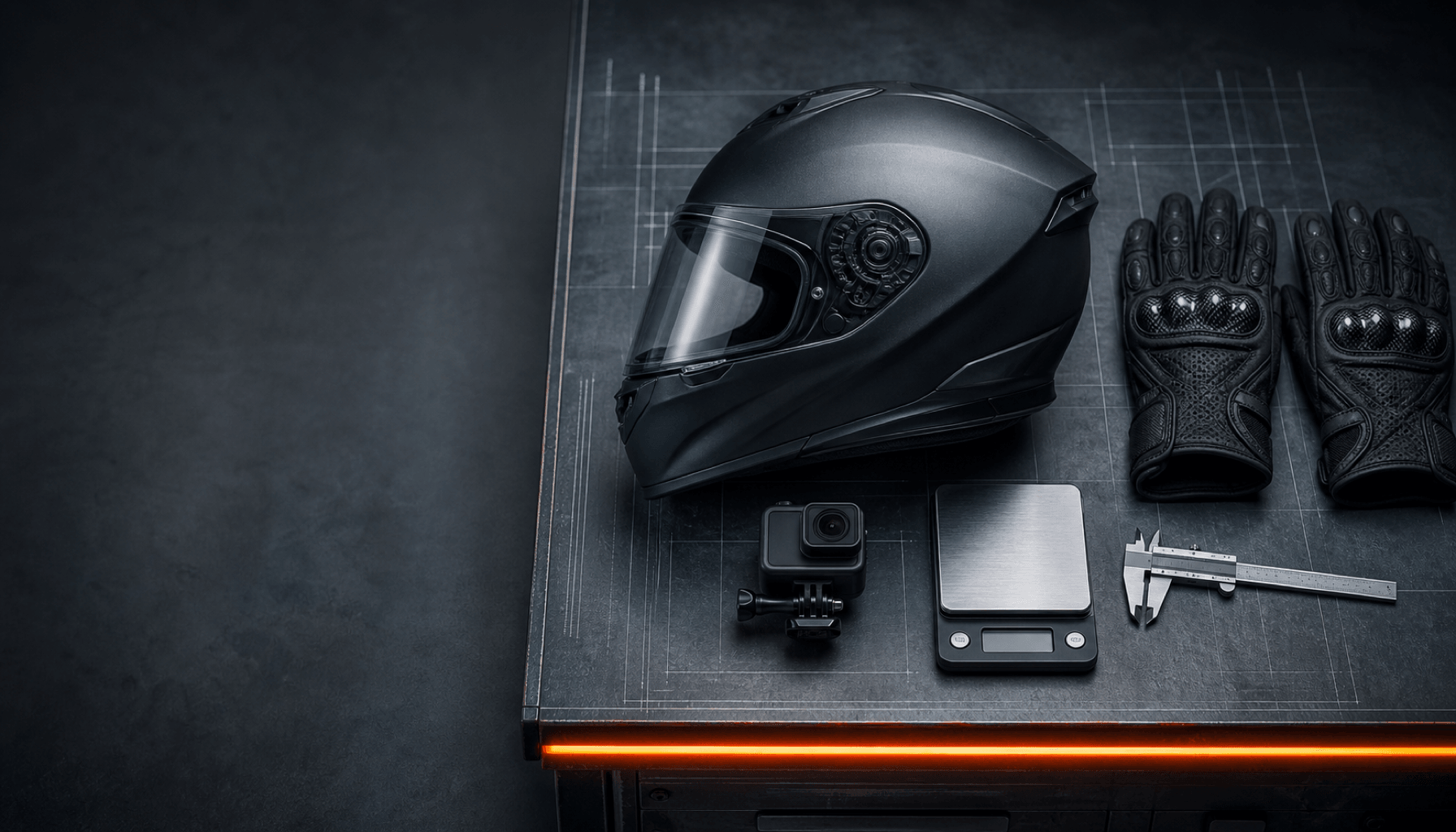
Gear editor Akira launches a new column dedicated to writing only about what they've tested on their own body. Measured values and felt impressions are kept separate, and gender is never the framing. In this launch issue, the lab declares its three rules, starting with helmets.
KEY TAKEAWAYS
- Gear reviews become comparable only when measurements are separated from impressions and usage time, body conditions, and loan status are disclosed.
- Prioritize real fit—head shape and hand dimensions—over gender labels, and record differences that emerge only during extended use.
As I start this column, I want to lay out this lab's rules first. There are only three. I only write about what I've tested on my own body. I keep measured numbers and felt impressions separate. And I never frame anything by gender. All three might sound obvious, but sticking to them consistently in gear reviews is actually not easy. Since coming out as non-binary, I've started trying every piece of gear that catches my interest, regardless of whether it's labeled men's or women's. What I realized in the process is that the gender field on the packaging carries almost no useful information for choosing gear. What matters is whether it fits your body. That's genuinely all there is to it.
Take helmets, for example. Before you even look at labels like 'M' or 'women's model,' what you should check is whether the shape of your head matches the shape of the interior padding. A head that's long front-to-back versus one that's wide side-to-side — even under the same size label, the pressure points land in completely different places. And things you simply can't tell from thirty seconds in a fitting room always reveal themselves after two hours on the road. Neck fatigue changes with even a slight shift in the helmet's center of gravity. Wind noise transforms completely depending on speed range. How the lining clings in summer heat, how positively the shield opens and clicks shut, whether you can operate the air intake with gloves on — I believe these are the things you only learn from long-term wear, and that's the real substance of a review. By the way, helmets are a consumable item, and manufacturers generally recommend replacing them a few years after production. Which means the chance to choose 'the next one' comes around regularly for everyone. I want to stack up articles here that are useful when that moment comes. That's why everything that appears in this lab is something I've actually ridden with and confirmed.
Let me also explain why I separate numbers from felt impressions. It's common for catalog weight to differ from measured weight, and even two helmets that are both listed at 1,500 grams can feel completely different depending on where the center of gravity sits. So in the lab, whatever can be physically measured gets measured and posted as raw numbers — weight, the number of steps to put it on, the force needed to operate it. On top of that, I write 'this is how it felt to me' in a separate paragraph from the numbers. I won't do the kind of inflated praise you see in ads. If something was borrowed from a manufacturer, I'll state clearly that it was borrowed. If something's bad, I'll say it's bad — but I'll always add for whom it's bad. It might just not fit my head, and still be the right helmet for you. I think the job of a review isn't to hand out a single right answer, but to give readers the material to choose for themselves.
A quick word on methodology too. Since I'm calling this a lab, I keep the measurement process consistent every time. Weight is measured on a kitchen scale as the baseline, and I note the gap from the catalog figure. For helmets, I log wearing time and record where it started hurting and at what hour. For gloves, I wait for a rainy day to go ride. For wearable cameras, I note both the manufacturer's stated battery life and the actual time until it overheats and shuts down under blazing midsummer sun. It's tedious work, I know. But I think review credibility can only be built from that kind of tedium, stacked up over and over. Of course, my own body is a sample size of one. That's why I always attach the physical premises behind my judgment — things like 'my head runs long front-to-back' or 'my hands have long fingers, 23cm' — every single time, so readers can calculate the difference between my body and theirs. I think that's the bare minimum of honesty required when doing reviews with a sample size of one.
The categories I'll cover include helmets, jackets, gloves, boots, wearable cameras, and pannier cases and bags. It's not just new products either — I'll also do 'six months later' follow-ups on staple gear that's started to wear down. Honestly, that might be the real point of this column. Almost no piece of gear is ever at its best on the day you buy it. Episode one will be a six-month review of a helmet I currently use every day — the kind of story about interior padding wear and changes in wind noise that you can never write in a brand-new first impression. The day you buy it is the performance peak, and how it degrades from there matters — because knowing that before you buy changes the meaning of the same purchase, even if the money spent is identical. I'm also open to requests. If there's a piece of gear you're curious about — 'what's this thing actually like' — let me know in the article comments, and I'll put it on the lab's test bench with priority. It's such a waste to narrow your options based on a gender label. Whether it fits is the only thing that matters. I'd be happy if this lab becomes a tool that helps you choose your next piece of gear.
Sources and references
Public information cited or consulted while preparing this original feature.