Dispatches from the World Custom Scene, Part 2: A Biarritz Summer — The Day Asian Builders Took Center Stage
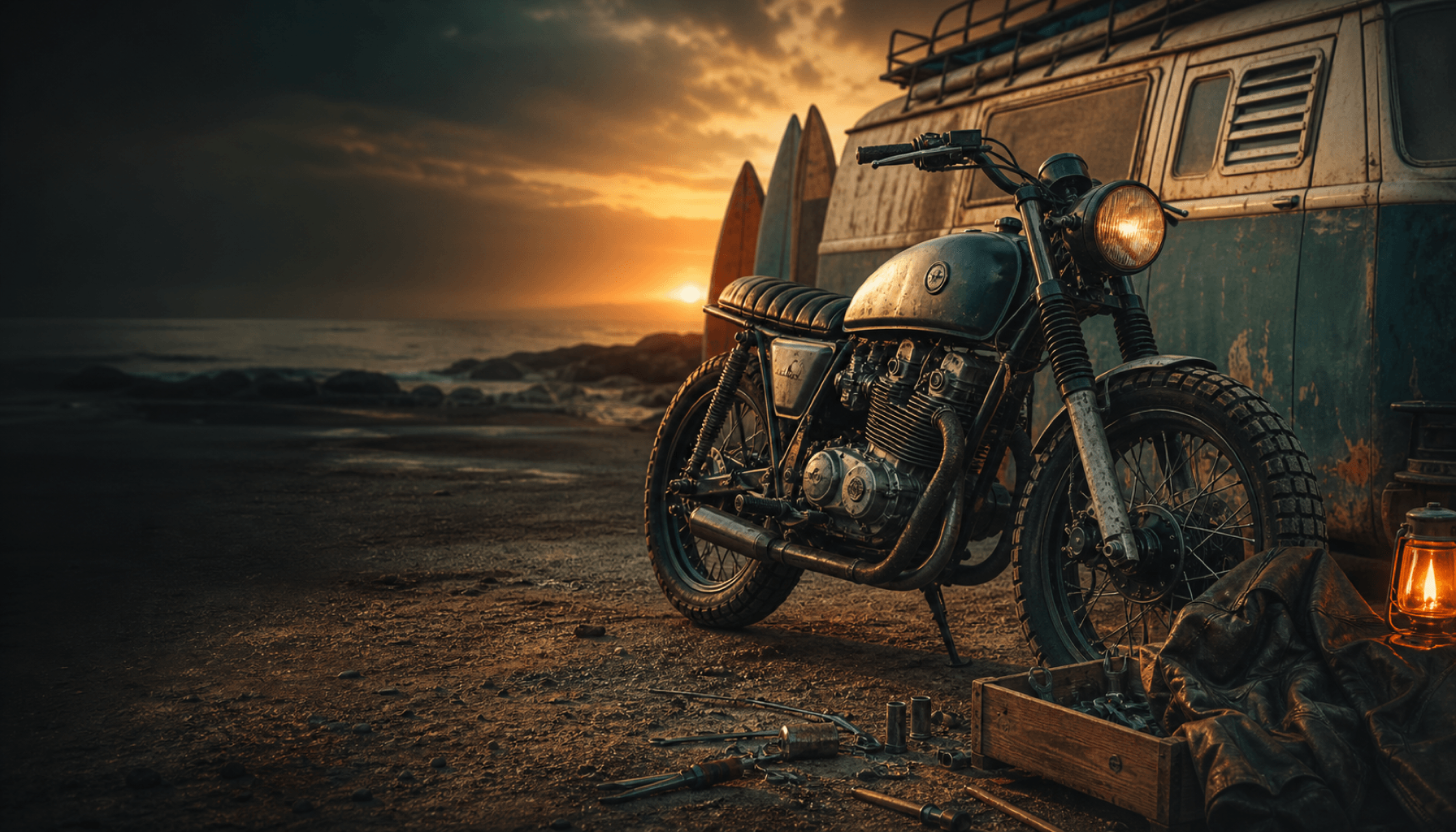
At this year's Wheels & Waves, the bikes I photographed the most weren't from Europe's storied houses or America's big names — they were built by Asian builders. A firsthand account of the tectonic shift, written while it's still fresh.
KEY TAKEAWAYS
- Wheels & Waves 2026 brought motorcycles, surf, and art together as a cross-border meeting point for custom culture.
- When build processes travel through social media, craft quality and local ideas matter more than where a builder is based.
As promised in our launch issue, this time it's about this summer in Europe. Biarritz, France, in June — Wheels & Waves. I've been coming to this festival for years, but this year the atmosphere was unmistakably different. The biggest crowds at the venue weren't gathered around Europe's storied shops or America's big names — they were around booths run by builders who'd flown in from Asia. I touched on this briefly in our editorial roundtable, but the heat on the ground that day can't be summed up in one line. So, true to what a "dispatch" should be, I'll go through what I saw in Biarritz in order.
First, what was on display. A café racer brought by a Thai shop was built on a small-displacement base, yet its presence was entirely "the real thing." Weld beads, hand-hammered aluminum, the sheen of the paint — the craftsmanship in the details held its own even set beside Europe's historic shops. A scrambler from Indonesian builders had a fascinating, independent take on suspension setup born from local road conditions, and other builders crouched down to peer at it. Japan had entries too, still commanding attention with its usual obsessive attention to detail. I'm not trying to make this about nationality. Every machine carried, given form, the necessity born from the roads and daily life of its home ground. That's what comes across to viewers — and that's why people gather.
Why did the Asian builders come this far? Talking to them directly on-site, the answer was clear: social media. Ten years ago, there was almost no way for a European tastemaker to know the work of a young builder in Bangkok. Now, every step of the workshop process flows out across the sea, and good work gets discovered regardless of borders. One young builder told me "more than half my orders now come from overseas." For them, exhibiting at Biarritz is both a dream stage and, at the same time, a chance to greet customers they already have. I wrote in our launch issue that custom culture has no center — this year's Biarritz was proof of that. It's not that the center of the culture moved. The very concept of a "center" has dissolved into a network where scene connects directly to scene. I welcome this change wholeheartedly.
Let me capture a bit more of the venue's atmosphere, as befits a dispatch. In the evening at Biarritz, in the square near the beach, bikes lined up with their engines off, the sea breeze mixing with the smell of sunscreen and leather. When someone starts strumming an acoustic guitar, a group whose nationalities you can't guess naturally forms a circle, complimenting each other's bikes through gestures and translation apps. At night, the talk is all about the sprint races. This year again, everything from vintage twins to electric bikes ran, and when the sound of a motor's whir followed the exhaust note, the crowd let out a gasp. Embracing that very gap in sound is part of what makes this festival's spirit so generous. Galette in hand from a food stall, I ran into the young Thai builder again who'd shown me his tank-hammering work earlier in the day. "I grew up reading a custom feature on your country in a Japanese magazine," he told me, and I was at a loss for words. The heat we'd been soaking in all along had crossed the ocean and become someone else's fuel. That's how culture circulates — it was a night that made oddly perfect sense on the sand.
One more scene that made me stop and think. A veteran European builder, watching the Asian booths, murmured, "The grammar we spent 50 years building, they're learning in five. Next, it'll be their turn to write the grammar." His face was half frustration, half respect. The custom world has long been a craftsman's world, where the belief was that passing down technique takes time. That common wisdom is being rewritten in the age of video and sharing. But we shouldn't forget: what you can learn through a screen only gets you as far as the form. The feel of a hand shaving metal, and the pain of failure — those you can only get in your own workshop. The Asian builders' work was the real thing precisely because they'd gotten their hands covered in oil too. My next dispatch will come in September, from Glemseck 101 in Germany. What will run at the airfield sprint this year? A motorcycle isn't just a vehicle — it's culture. I'll keep reporting from the front lines.
P.S. Once I've sorted through the photos I took in Biarritz, I want to find a way to show them to you somehow. The light on the sand and chrome I saw through the viewfinder is something words alone can only convey half of. Enclosing photos with a letter — that's what a dispatch is supposed to be, after all. Until then, go show your face at the garage in your own city too. Culture doesn't come to you while you wait. You have to go meet it. My toolbox is, today too, packed at the very bottom of my luggage for the next trip.
Sources and references
Public information cited or consulted while preparing this original feature.
![[Video] MV Agusta Unveils the Brutale 1000 ABT, a Special Model Collaboration With ABT](/_next/image?url=https%3A%2F%2Febcyllahemayvlukmyyw.supabase.co%2Fstorage%2Fv1%2Fobject%2Fpublic%2Farticle-images%2F1121d65b-0a25-4d21-9077-46c76a5ab102.jpg&w=3840&q=85)