Motorcycles on Screen, Part 2: On 'Aitsu to Lullaby' — The Sleepless 16-Year-Old and the Midnight Waterfront
Revisiting Michiharu Kusunoki's landmark work, which captured the fever of the '80s bike boom, through a critical lens. Why does the story of a boy and his Z still keep readers up 40 years later? The origin-story essay promised in issue one.
KEY TAKEAWAYS
- Aitsu to Lullaby treats the motorcycle not as a prop but as a partner reflecting youth, freedom, and friendship.
- Reading its Kawasaki imagery alongside 1980s bayside culture helps explain the manga’s continuing influence on real-world classic-bike enthusiasm.
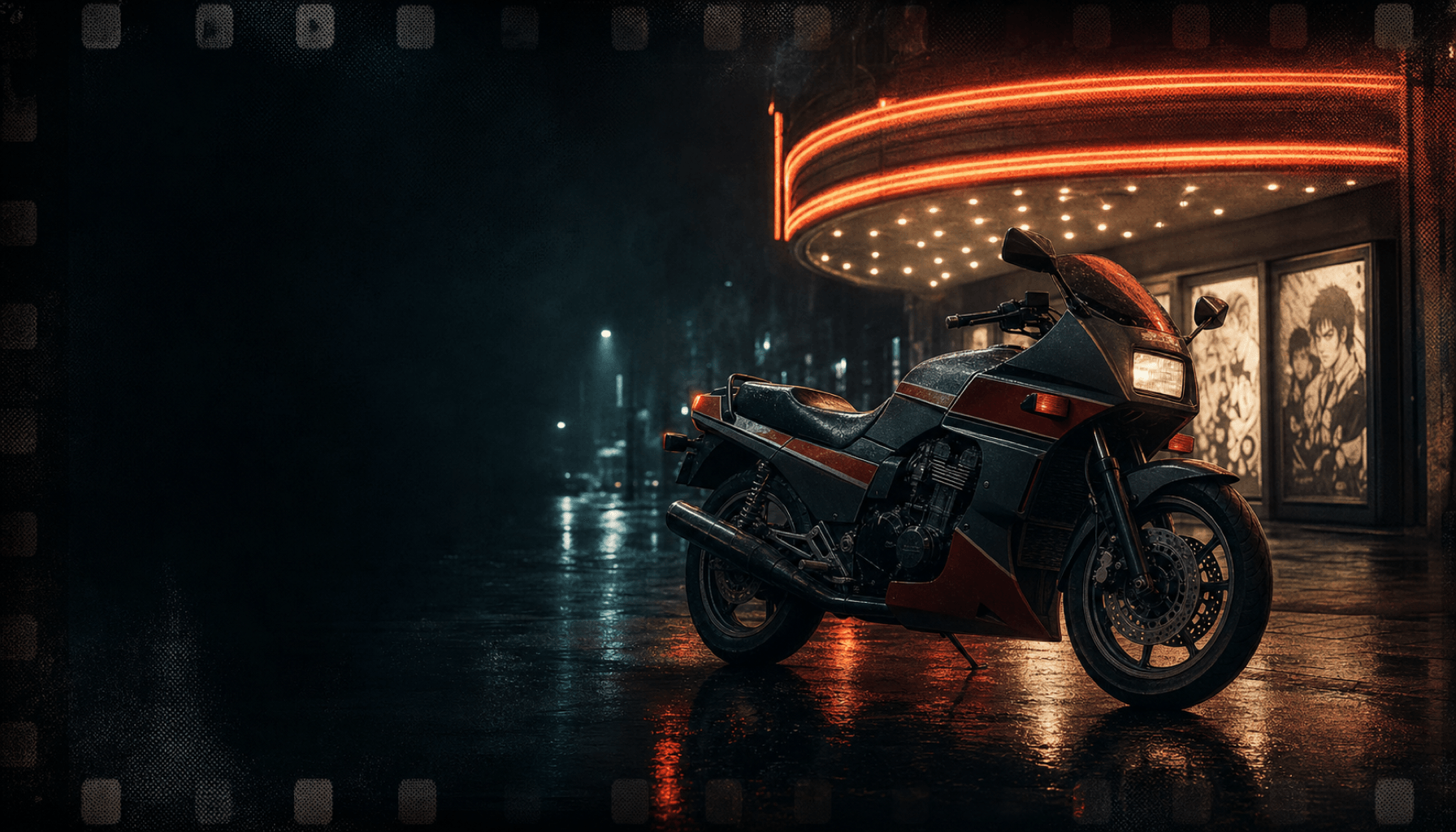
As promised, this time I want to talk about "Aitsu to Lullaby" (That Guy and Lullaby). As I wrote in our launch issue, this is the work that made me love motorcycles before I even knew anything about them. So this installment inevitably gets personal. Still, I've decided to write it in critical terms, because setting nostalgia aside, this manga is a genuine singularity in the history of motorcycle comics. Michiharu Kusunoki's story ran during the 1980s — the peak of Japan's motorcycle boom — depicting the days of a boy and his Kawasaki Z racing along the midnight waterfront. I know of no other work that captures the air of that era so vividly.
What made this work so singular? First, the way it portrays the motorcycle. In many stories, the bike is drawn as the protagonist's "possession" or an "extension of his ability." But the Z in "Aitsu to Lullaby" is different. It's a character. To the protagonist, Kenji, the Z isn't a means of transport or a tool for speed — it's drawn as a partner he talks to, who puts up with his recklessness, and who sometimes protects him. The very structure of the title — where "aitsu" ("that guy") can be read as referring to the bike itself — was itself the work's invention. I consider it one of the earliest works to place at the core of its story that hard-to-explain affection riders feel for their machines — the psychology that makes you call your bike "this guy."
Second is its resonance with the era. The 1980s motorcycle boom wasn't a mere fad; it was a central battleground of youth culture. As a symbol of freedom glimpsed outside the classroom window, the motorcycle was dazzling, yet carried a whiff of danger. The story never looked away from either the light or the shadow. The midnight waterfront setting was "another school" outside the regulated world of daytime, where the boys traded speed for lessons in responsibility and loss. What kept my 16-year-old hands turning the pages wasn't the thrill of speed — I understand now, at 38, that it was probably this premonition of becoming an adult. Motorcycles on screen always carry more than their raw performance specs — that's the thesis I laid out in the first installment, and this is its origin point.
It wouldn't be fair not to mention the author's later career. After this work, Kusunoki went on to create a landmark car manga set on the midnight expressways of the capital. Even after shifting to four wheels, the grammar remained consistent: calling the machine "aitsu," and placing the relationship between person and machine at the center of the story. In later years he returned once again to motorcycle-themed works. In other words, this creator has kept digging at the same question across vehicle genres — why are people captivated by speed, and what does it mean to converse with a machine? Once you see this work as the origin point, its coordinates become visible not just in the history of motorcycle manga, but in the broader cultural history of Japan's motorization. Even after the '80s boom faded and regulation and social scrutiny grew stricter, this grammar was passed down without interruption. Because there was a narrative style that portrayed the motorcycle not as a delinquent's badge but as a conversation partner, later creators had a foothold to depict motorcycles as part of everyday life. Culture doesn't continue through rupture — it continues through the inheritance of grammar. We happen to be the generation that got to read the starting point of that inheritance in real time.
Now let's ground this in reality. The influence this work had on what followed is immeasurable. The grammar of portraying the bike as a partner became standard equipment for motorcycle manga thereafter. And in the real world, the air-cooled Z lineage the boys rode in the story remains, 40 years later, in a class of its own in the vintage market. Of course, the price surge is a complex phenomenon, but I find it hard to believe it's unrelated to the fact that the manga and screen adaptations of that era etched "me, riding a Z" into hundreds of thousands of minds. A story doesn't end when it's consumed — it lingers even in readers' purchase histories. This is the moment where pop culture criticism connects to the economics of motorcycles. Next time, I'll cover another origin point for this column — "Top Gun" and the GPz900R. Those few dozen seconds when a screen changed the fate of a single motorcycle. My 36-years-later reckoning with Maverick.
Finally, I'll confess: rereading this work to write this piece, I ended up watching the sun come up again. In the same place as that 16-year-old night, my 38-year-old hands couldn't stop turning the pages either. Stealing a reader's night across generations — if there's a definition of a masterpiece, that's probably enough of one. Somewhere tonight, a motorcycle on screen is stealing someone's sleep again. And that's exactly as it should be. Enjoy your reading — and your late night — tonight too.
Sources and references
Public information cited or consulted while preparing this original feature.