World Custom Dispatch #3: 36 Units, Sold Out — The Year Custom Work Became a Product
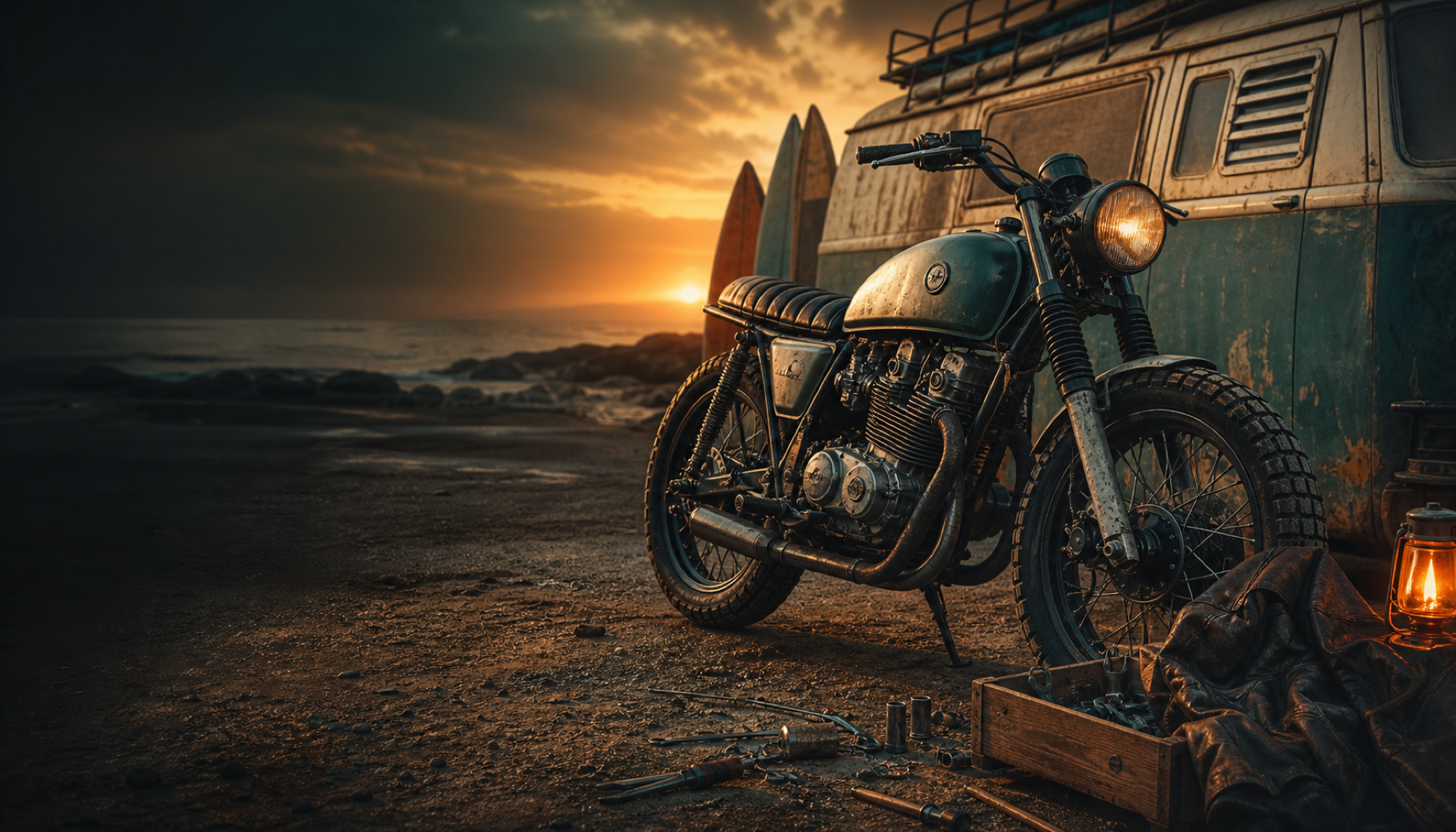
WalzWerk's Royal Enfield sold out at 36 units, TÜV-approved and warrantied, in the same week Harley filed trademarks for a factory cafe racer. Once certification and a warranty are attached, a one-off becomes a product.
KEY TAKEAWAYS
- WalzWerk's first non-BMW build — a Royal Enfield Interceptor 650 cafe racer — sold out at 36 units and €14,900 each, with TÜV approval, the factory warranty plus two years of its own, and weight cut from 215kg to about 190kg.
- Harley-Davidson filed the RMCR and RMXR trademarks with the USPTO on July 29, 2026. RMCR is a cafe racer built on the 1250cc Revolution Max — the first factory Harley cafe racer since the XLCR of the late 1970s.
- The one-off scene is still alive: Glemseck 101 runs September 4–6, 2026 at Solitude with free admission and pre-registered riders for its eighth-mile knockout sprints, while the Cycle Source Bike Show at Sturgis has added a new Builder’s Choice Award.
Last time I wrote from Biarritz — how the biggest crowd at Wheels & Waves gathered around the builders who had come from Asia. Two months on, the movement has shifted to the workshop side. Markus Walz of WalzWerk in Germany has, for the first time, built on something other than a BMW: a jet-black cafe racer on the Royal Enfield Interceptor 650. Thirty-six numbered units as a First Edition, €14,900 each, already sold out, deliveries from May 2027. What caught me was not the unit count or the price. It was what comes attached to them.
TÜV approval is included, Royal Enfield's factory warranty stays intact, and WalzWerk adds two years of its own on top. Weight drops from 215kg to about 190kg, so roughly 25kg gone. Walz says the price works out to about half of what a Schizzo conversion on a BMW base costs, and that the point was to bring proper build quality down to where younger riders can reach it. He has also announced a Scrambler and a Roadster on the same platform. At that point it is not a one-off collaboration. It is a product line. My read: this is closer to a low-volume manufacturer than to custom work. The moment certification and a warranty are attached, it stops being a one-off from a workshop and becomes a product.
The same week brought the story from the other direction. On July 29, Harley-Davidson filed the trademarks RMCR and RMXR with the US Patent and Trademark Office. RMCR is the cafe racer built around the 1250cc Revolution Max, already shown in the metal at Mama Tried in Milwaukee, at Daytona and at the MotoGP round at Circuit of the Americas. It would be the first factory Harley cafe racer since the XLCR in the late 1970s. RMXR looks to be a flat tracker in the line of the XR750 and the XR1200. A factory selling you a cafe racer straight off the floor — I am all for it. I just look at it from a different angle. I only have one yardstick for a new bike: will it be raw material for a builder five years from now?
To be clear, the one-off is not dead. That same week, Woidwerk in Germany rebuilt a BMW R12 G/S into a canyon carver: the front wheel dropped from the factory 21-inch to a 19, an Arrow manifold with a Hattech silencer, pre-muffler and catalytic converter cut out. The paint is hand-done by Stilbruch-Lack in a comic, sketch-like style, as if a 2D drawing had been pulled into three dimensions. It is a single machine, built together with the dealership and BMW Motorrad Austria, and it debuted at the Newchurch Summit in Austria. That is the exact opposite of a 36-unit edition. No order book, no warranty card — but one person's taste runs through it without bending once. That both of these landed in the same week is the part I find meaningful.
Line them up against my yardstick and you get an interesting inversion. The Interceptor 650 is cheap and honestly built, which is why Walz picked it — it is good raw material. A cafe racer finished at the factory, on the other hand, is complete the moment you buy it. The room to modify has been machined out in advance. Neither is nobler than the other. But the more finished products there are, the quieter the supply of raw material gets. Which is why you have to go and look. September 4–6, Solitude, Glemseck 101. Knockout sprints over an eighth of a mile, with classes like 101 Sprint International, 101 Cafe Racer and 101 Classic Racer. More than a hundred exhibitors, free admission, spectators standing at the edge of the strip. Riders have to register with race control in advance. What is fast there is not a catalogue. It is somebody's hands.
The same smell is in the air in the States. Turn 14, the aftermarket distributor, has come in as presenting sponsor of the Cycle Source Bike Show at Sturgis on August 9. Thirty classes judged, $5,000 for Best of Show — and the new prize they have added is called the Builder's Choice Award. That builders now have an award deliberately chosen by builders looks symbolic to me: it is a decision to keep a standard of judgement somewhere outside the catalogue. And the fact that 36 units vanished in a day proves plenty of people will still pay for handwork. That part I am simply glad about. But the more products there are, the more someone has to make sure raw material survives. A motorcycle isn't a vehicle, it's a culture. And a culture does not continue through finished products. Hands that modify things keep it going. So in September, I am going to Solitude.
Sources and references
Public information cited or consulted while preparing this original feature.
- Moto.it: Markus Walz's first Royal Enfield, an all-black cafe racer
- Motorcycle.com: Harley-Davidson files trademarks for RMCR and RMXR
- Bike EXIF: Woidwerk's canyon-carver BMW R12 G/S
- Glemseck 101 official: September 4–6, 2026, eighth-mile sprints and class list
- Powersports Business: Turn 14 sponsors the Cycle Source Sturgis Bike Show
![[Video] MV Agusta Unveils the Brutale 1000 ABT, a Special Model Collaboration With ABT](https://ebcyllahemayvlukmyyw.supabase.co/storage/v1/object/public/article-images/1121d65b-0a25-4d21-9077-46c76a5ab102.jpg)