Anatomy of a Classic #5: The Manx Name — A Hundred in 1951, a Hundred in 2026
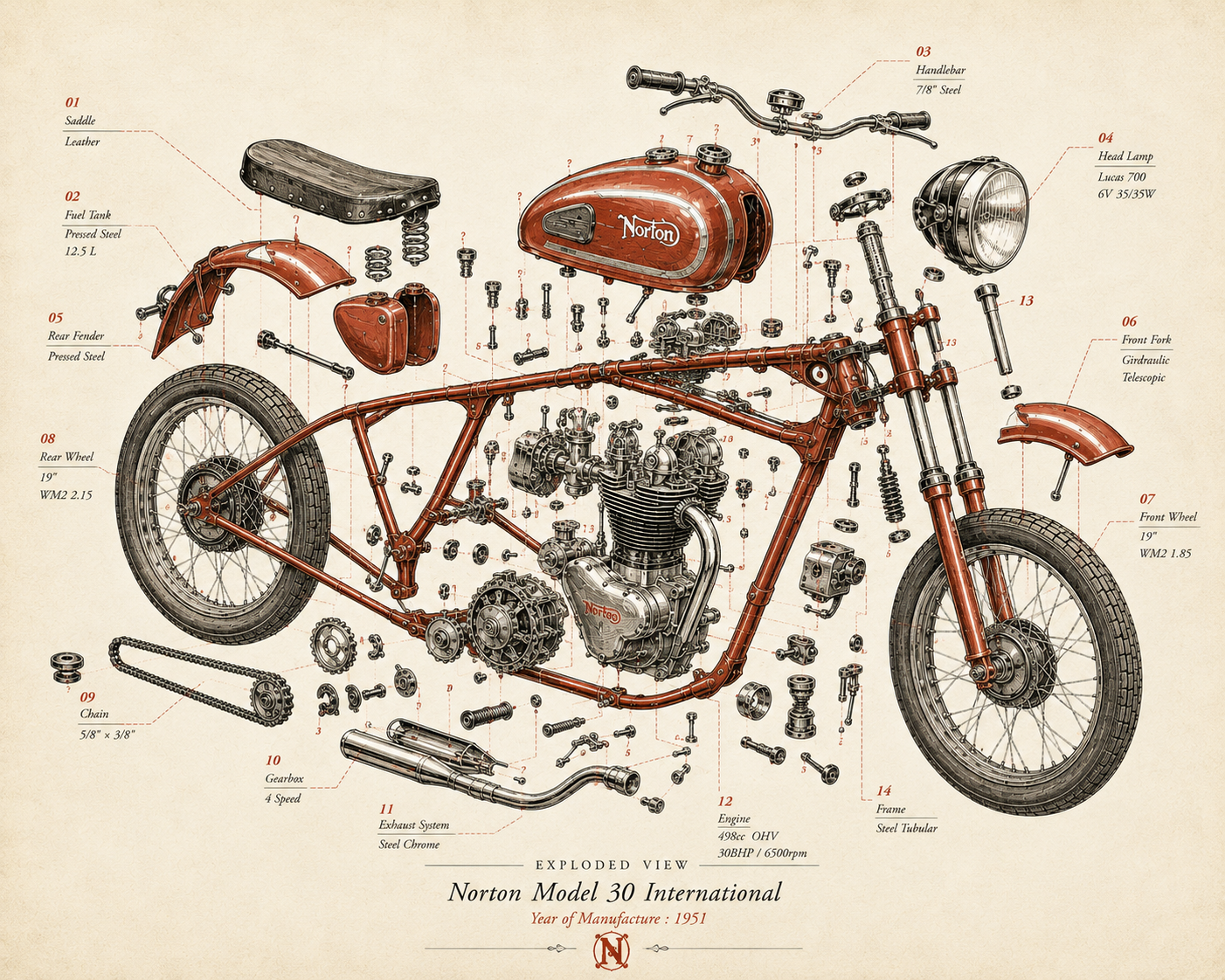
Norton has disclosed how the Manx R was developed: over 100 prototypes and more than 500,000km of testing. Set that against the original Manx — under 100 hand-built units a year — and you can see what the name has come to mean.
KEY TAKEAWAYS
- Norton built more than 100 Manx R prototypes and ran over 500,000km of validation riding and 700-plus tests across five countries. The 1200cc 72-degree V4 makes 206hp at 11,500rpm, with UK prices from £20,250.
- From 1951 to 1963 the Manx was built at fewer than 100 units a year by fewer than ten craftsmen — a racer sold so the buyer could enter the TT himself. The meaning of "a hundred" has been inverted.
- In the Manx R's real-world telemetry, over 98% of riding time across 218,000km from more than 50 riders fell between idle and 7,000rpm — the peak of its 206hp sits in a region almost nobody uses.
Norton has opened up its development file on the Manx R. More than 100 prototypes. Over 500,000km of development and validation riding, some 20,000km of it on track. More than 700 individual tests, and feedback from over 50 riders, including Isle of Man TT winners. The work was centred on the company's R&D site in Solihull, England. Cycle News and MCN both carried the figures on 13 August 2026. Reading down that column of numbers, I found myself thinking about a different hundred: the other Manx, built at fewer than 100 units a year from 1951 to 1963.
The Manx name belonged, from the start, to a racer that was sold. In 1947, after the war, Norton offered its SOHC single fully equipped for racing under that name. The turning point came in 1950. A new frame designed by the McCandless brothers of Belfast — a twin-downtube steel cradle — went under the works machines. Harold Daniell, asked what it was like to ride, said it was like riding on a feather bed, and the nickname stuck. At that year's Isle of Man TT, Geoff Duke took a record-breaking Senior win and Norton locked out the first three places in both the Senior and the Junior. In April 1951 the same frame was released to the Manx models sold to private owners.
This is the part that matters. The Manx of that era was a machine bought so the owner could go racing on it. Fewer than 100 left the works each year, hand-built by fewer than ten craftsmen. Buyers loaded them onto their own vans and entered the TT themselves. Development did not end inside the factory; it continued on the roads and circuits the bikes were sold into. The maker supplied half of it, and the rider filled in the rest. That relationship held until the last Manx rolled out of Bracebridge Street in January 1963.
What that relationship produced is still there in the results. In 1963, the year production ended, nine of the top 20 places in the 500cc world championship went to riders on a Manx. The factory was already withdrawing, and yet the machines it had sold were still in service. That is the particular kind of lifespan a racer-for-sale has: as long as buyers keep running it, the machine keeps being developed. Fewer than a hundred hand-built units a year, accumulated over more than a decade, kept filling the upper order of the world championship — less a demonstration of the factory's strength than of the sheer number of people who bought one.
The 2026 Manx R uses the same number in the opposite direction. Its hundred is not the number sold, but the number ridden and broken before anything was sold. It was the manufacturer, not the customer, who covered 500,000km; after 700 tests across five countries, one finished machine reaches the showroom. The 1200cc, 72-degree V4 makes 206hp at 11,500rpm and 130Nm at 9,000rpm. Prices start at £20,250 in the UK and rise to £38,750 for the carbon-clad Signature. Chief technical officer Brian Gillen has said rider feel was treated as a hard requirement rather than a nice-to-have — an engineering discipline in which hitting the performance numbers alone is not enough to sign a bike off.
The line I sat with longest was from the real-world telemetry. Across 218,000km logged by more than 50 test riders, over 98% of riding time fell between idle and 7,000rpm. The peak of those 206 horsepower lives in a region almost nobody visits. Norton knew that, and built up the part that actually gets used. Look back through the history and the Norton of the Manx years did the reverse: the road was the buyer's problem, and the factory could afford to look only at racing. The fact that Isle of Man TT winners sit among those 50 test riders should be read as a symbol rather than an irony. The people who once bought a machine in order to enter the TT are now invited in to decide whether a production bike passes. And the word those riders reached for — a feeling of connection — says a good deal about what kind of machine this is.
A name can be borrowed. What the name once meant cannot. The 1951 Manx was a machine that left room for the rider to finish it. The 2026 Manx R is finished before it is handed over. I do not read that as decline. The main battleground moved to the public road, and breaking a hundred machines is what fighting there now demands — that is simply what this era asked for. But as that margin disappeared, so did the work that once belonged to the buyer. Having declared that it will carry the weight of the Manx name, will this machine also carry the change in the relationship that name once stood for?
Sources and references
Public information cited or consulted while preparing this original feature.
![[Video] MV Agusta Unveils the Brutale 1000 ABT, a Special Model Collaboration With ABT](https://ebcyllahemayvlukmyyw.supabase.co/storage/v1/object/public/article-images/1121d65b-0a25-4d21-9077-46c76a5ab102.jpg)