Spec Obsession Diary Vol.5: M Isn’t Horsepower — BMW Starts Subtracting From the 1300 GS
Five BMWs have leaked for EICMA 2026. The M 1300 GS keeps 145 hp and subtracts — radar units gone, smaller tank — while the M 1000 RS adds, putting over 200 hp into a sport-tourer. The same badge, pointing two ways.
KEY TAKEAWAYS
- The M 1300 GS prototype runs 21-inch front and 18-inch rear spoked wheels on Metzeler Karoo tyres, with longer suspension travel and a reinforced swingarm support, while the 145 hp R 1300 GS boxer appears to carry over unchanged.
- The M 1300 GS is defined more by removal than addition: the front and rear radar units come off, it uses the smaller standard tank rather than the Adventure unit, and mass is cut with materials such as titanium.
- The M 1000 RS is already certified for 2027 by both the US EPA and CARB. Its 999cc inline-four is read as 205 hp at 13,000 rpm for the US, with European reporting citing 218 hp, and it is estimated to weigh more than the M 1000 RR’s 428 lb.
- The leaks differ in confidence: the M 1000 RS rests on certification filings, the S 1000 RR on an Indian design patent (its 215 hp and May 2027 production start still rumour), and the M 1300 GS and F 600 GS on spy photographs alone.
Last time I wrote about a "7" that turned out not to be a displacement figure. This time I want to talk about a letter rather than a number. European outlets are circulating a leak of five bikes BMW is said to be preparing for EICMA 2026 — the M 1300 GS, the M 1000 RS, the S 1000 RR, the F 600 GS, and a mid-cycle refresh of the R 1300 GS. Laying the spec sheets side by side, what caught me is that two of them carry an M. At BMW, M is the motorsport badge, and the reasonable assumption is that it signals more horsepower. Yet these two Ms point in completely opposite directions. That is the part I love.
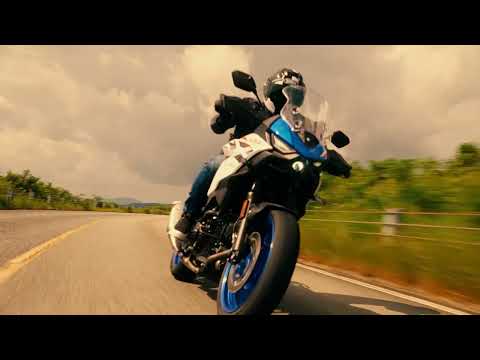
Start with the M 1300 GS. A covered prototype has been photographed near the Munich development centre, running 21-inch front and 18-inch rear spoked wheels shod with Metzeler Karoo tyres. Suspension travel has been lengthened, and the swingarm support on the final-drive side is reportedly reinforced and revised. The engine, though, looks to be the 1300cc liquid-cooled boxer essentially unchanged. The base R 1300 GS makes 145 hp at 7,750 rpm and 110 lb-ft (roughly 149 Nm) at 6,500 rpm. Wearing an M does not appear to send those figures anywhere. What it does instead is subtract. The tank is the smaller standard unit rather than the big Adventure item. The front and rear radar units come off. Mass is shaved with expensive materials such as titanium, most likely in the exhaust. The brakes are the M items with those blue calipers. Compared with the model it is based on, this looks like a bike defined more by what has been removed than by what has been added. And it is expected to cost $8,000 to $12,000 more than the standard variants. A motorcycle whose price goes up as the radar comes off sounds absurd written down, but it is consistent with how the M range has been priced before. A reveal is expected before the 2027 riding season, possibly as early as autumn 2026.
The M 1000 RS sits on the addition side of the same letter. The US EPA and CARB have each independently certified it for the 2027 model year, so this is paperwork rather than rumour. The engine is the 999cc inline-four. Because CARB's emissions data matches the 2026 M 1000 RR, the reading is that the US version carries the same 205 hp at 13,000 rpm and 83 lb-ft at 11,100 rpm. European reporting, however, puts it at 218 hp, framing that as five or six horsepower above the current figure. Equivalent inertia mass data suggests it will be close to 10 kg heavier than the M 1000 RR's 428 lb (about 194 kg). RS stands for Reise und Sport — travel and sport. Putting north of 200 hp into a sport-tourer is a gloriously questionable use case, and honestly this is the one that spikes my heart rate. It is said to slot between the M 1000 RR and the M 1000 XR with improved aerodynamic wind protection. One bike drops equipment and heads for the dirt; the other keeps the equipment and heads for speed. The same two characters, used in exactly opposite directions.
One more thing worth writing down: leaks come in grades of evidence. The M 1000 RS rests on EPA and CARB certification, which is the top tier. The S 1000 RR rests on a design patent filed in India plus its resemblance to the Concept RR shown at Villa d'Este — mid-tier — and the 215 hp figure with production starting in May 2027 is still rumour. The M 1300 GS and the F 600 GS (estimated 590-600cc twin, 65-70 hp, 21/18-inch wheels, aimed squarely at the Ténéré 700 and the Transalp) rest on spy photographs alone. The fifth bike, the R 1300 GS, is read as an engine-unchanged cosmetic refresh with new colours, which barely deserves the word "leak" at all. Filed under the single word "leak" they look equivalent, but their confidence levels are nothing alike, and as a spec obsessive I want to read them without flattening that difference. With that said, the M 1300 GS is the more interesting story here. If M is shifting from a symbol of speed to a symbol of what was given up for a purpose, then the meaning of the badge itself is being rewritten. Will that company really build an M that stays at 145 hp and commits all the way to dirt? We can check the answer in Milan this autumn.
Sources and references
Public information cited or consulted while preparing this original feature.