Spec-Obsession Diary Vol. 2: 78 hp for About ¥600,000 — Dissecting the Numbers Behind the CFMoto 500SR
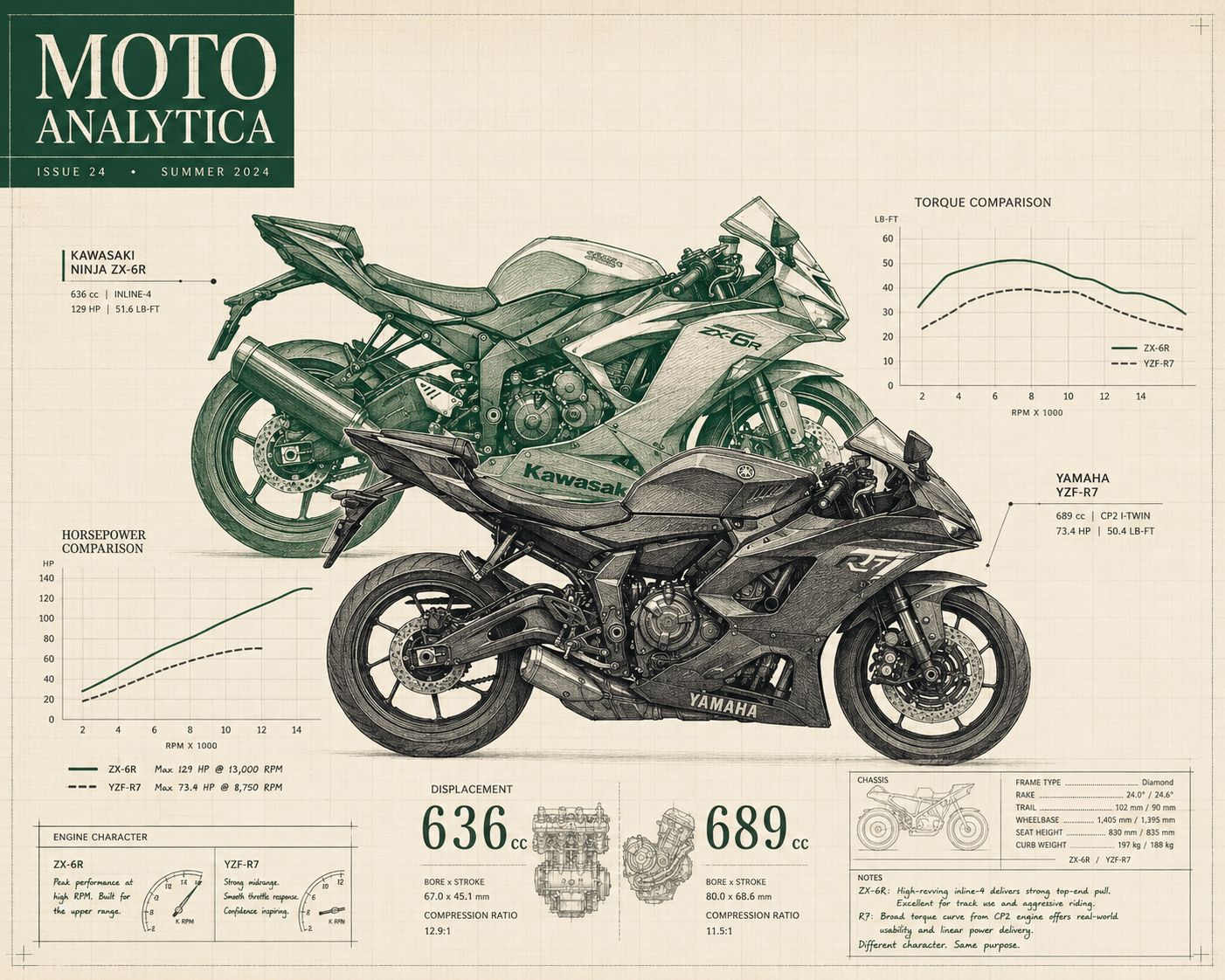
Four cylinders, 78 hp, about ¥600,000. The numbers behind CFMoto's newly announced 500SR are shattering the conventional wisdom of the middleweight class. A man who loves spec sheets a little too much dissects this price-breaking machine, line by line.
KEY TAKEAWAYS
- Built around a four-cylinder engine, the CFMOTO 500SR challenges middleweight sport-bike value through its mix of price, power, and weight.
- The development path toward the V4 SR-RR shows CFMOTO aiming beyond low-cost substitution toward a genuine performance brand.
It's been a while since a spec sheet made me do a triple take. CFMoto has announced a four-cylinder sport bike, the 500SR. Peak output: 78 hp. Price: about ¥600,000. The mere fact that these two numbers appear on the same page is already an event. This Vol. 2 continues the numerical comparison of 2026 superbikes I did in the launch issue, and I want to thoroughly dissect the numbers behind this one machine. Full disclosure up front: I haven't ridden the actual bike yet. So this isn't a story about ride feel — it's purely a story about numbers. But then again, there aren't many bikes you can talk about this much using numbers alone.
Let's start with the layout itself: a four-cylinder engine in a 500cc-class bike. It's a design that wrings out power by spinning small, roughly 125cc-per-cylinder combustion chambers to high revs — a grammar perfected by Japan's 400cc multis from the late '80s through the '90s. In recent years the middleweight class has been dominated by cheaper-to-build twins, and small-displacement fours had become nearly an endangered species. Now a Chinese manufacturer is bringing them back. And that 78 hp figure puts it a full head above the current domestic 400cc class. They clearly understand how weak our generation is for the sensory thrill of a high-revving multi — that metallic howl reminiscent of a cam-gear train.
Next, let's dissect the price. About ¥600,000 for 78 hp works out to roughly ¥7,700 per horsepower. Looking at it through this 'price per horsepower' lens, while most of today's popular middleweights sit in the low ¥10,000s per horsepower, the 500SR is clearly a notch cheaper. Of course there are costs that don't show up in the numbers — the maturity of the electronics, the finish of the details, the dealer network, resale value. Even discounting for all of that, I read this pricing as a declaration: 'Let us onto the mat first.' What shouldn't be forgotten is that CFMoto simultaneously announced a 997cc V4 superbike, the V4 SR-RR — the first liter-class V4 from a Chinese manufacturer. Attack from below with price, attack from above with technology. You can read this two-front design philosophy clearly across the two spec sheets.
While we're on the subject of numbers, let me also share how I 'read' a spec sheet. For a new bike in this class, the first thing I check isn't output — it's the equipment list. Is the throttle electronically controlled (ride-by-wire)? How many stages does the traction control have? Is a quickshifter standard? Are the lights full LED? Is the meter a TFT display? Checking those five points tells you roughly when the bike was designed and where the cost was spent. This kind of equipment used to be the privilege of the liter class; it never trickled down to middleweights and below. But newer manufacturers, riding the wave of shared parts and electronics, are loading it generously even onto smaller classes. If anything, 'startle them with equipment, then step onto the mat' seems to be their standard playbook. Of course, just as more traction-control stages doesn't necessarily mean higher-quality intervention, having a feature and having it refined are two different things. Even so, the mere fact that this equipment list exists at the ¥600,000 price point is a change that would have been unthinkable a few years ago, and I found myself nodding repeatedly as I read the catalog. A spec sheet doesn't lie, but it doesn't tell you everything either. That's exactly why you need the skill to read between the lines.
Finally, I want to think about what these numbers will do to the market. If a ¥600,000 four-cylinder actually lands in dealerships, the segments most shaken up will be the 'first bike' market and the 'second bike' market for people adding to their garage. Same budget, but now a choice between a domestic twin or an upstart four — a scale that simply didn't exist before. And whether rivals respond by cutting prices or piling on equipment, the outcome for readers can only move in the direction of more choice. What I genuinely want to verify is how much of that claimed 78 hp shows up on an actual dyno, and how vibration is managed at five-figure rpm. As someone who's made comparing bikes to their predecessors a life's work, this particular machine excites me precisely because there is no predecessor to compare it to. Once real-world testing comes in, I'll absolutely be writing a follow-up. Through the spec sheet, you can just make out the shape of a changing era.
By the way, this time I stayed up with my calculator longer than almost ever before. Before I knew it, the sky outside my window had brightened, and honestly, I amazed even myself. But nights like this are exactly why I write this column. Diving into an ocean of numbers to be the first to spot a turning point in the times — that's the privilege of a spec-obsessed nerd. With new-model announcements coming one after another this season, my heart rate is probably going to stay elevated for a while. And I've already decided which machine goes on the dissection table next.
Sources and references
Public information cited or consulted while preparing this original feature.